MA in Child and Adolescent Psychotherapy


Blended learning programme

Develop specialist skills in working therapeutically with children and adolescents. 

This programme prepares practitioners to work effectively with young people experiencing emotional, behavioural and psychological challenges. They will explore developmental theory, trauma-informed practice and integrative therapeutic approaches tailored for children and adolescents. The programme combines academic learning with clinical insight, supporting practitioners to build safe, responsive and developmentally appropriate therapeutic relationships. 

Request information about this programme:

"*" indicates required fields

This field is for validation purposes and should be left unchanged.

Programme Type: MA in IC & AP
Next Intakes: Autumn 2026

NFQ: Level 9
ECTS: 120 credits

Academic Validation: QQI

Professional Accreditation: N/A

Overview

Introduction

Child and adolescent psychotherapy is a specialised area of practice. This master’s programme will equip learners with the necessary knowledge, skills and competencies to meet the therapeutic needs of children and adolescents.

With a strong focus on excellence in clinical practice, learners are fully supported in transitioning from being practising therapists with adults to clinical work with children and adolescents. A safe, nurturing environment is fostered through established links with an on-site placement centre.

Who Should Apply

This two-year programme will be of interest to practising counsellors, psychotherapists and play therapists who wish to extend their existing qualifications in counselling and psychotherapy to master’s level and work with children and adolescents.

Entry Routes
  • An honours degree, Level 8 on the National Framework of Qualifications (NFQ) in counselling and psychotherapy, or equivalent

Or

If English is not your first language, you need to submit an International English Language Testing System (IELTS) certificate at Level 6.5 or equivalent. (View more information

Learners will be invited to an interview with faculty as part of the application process.

Minimum Technological Requirements

You will need:

Course Information

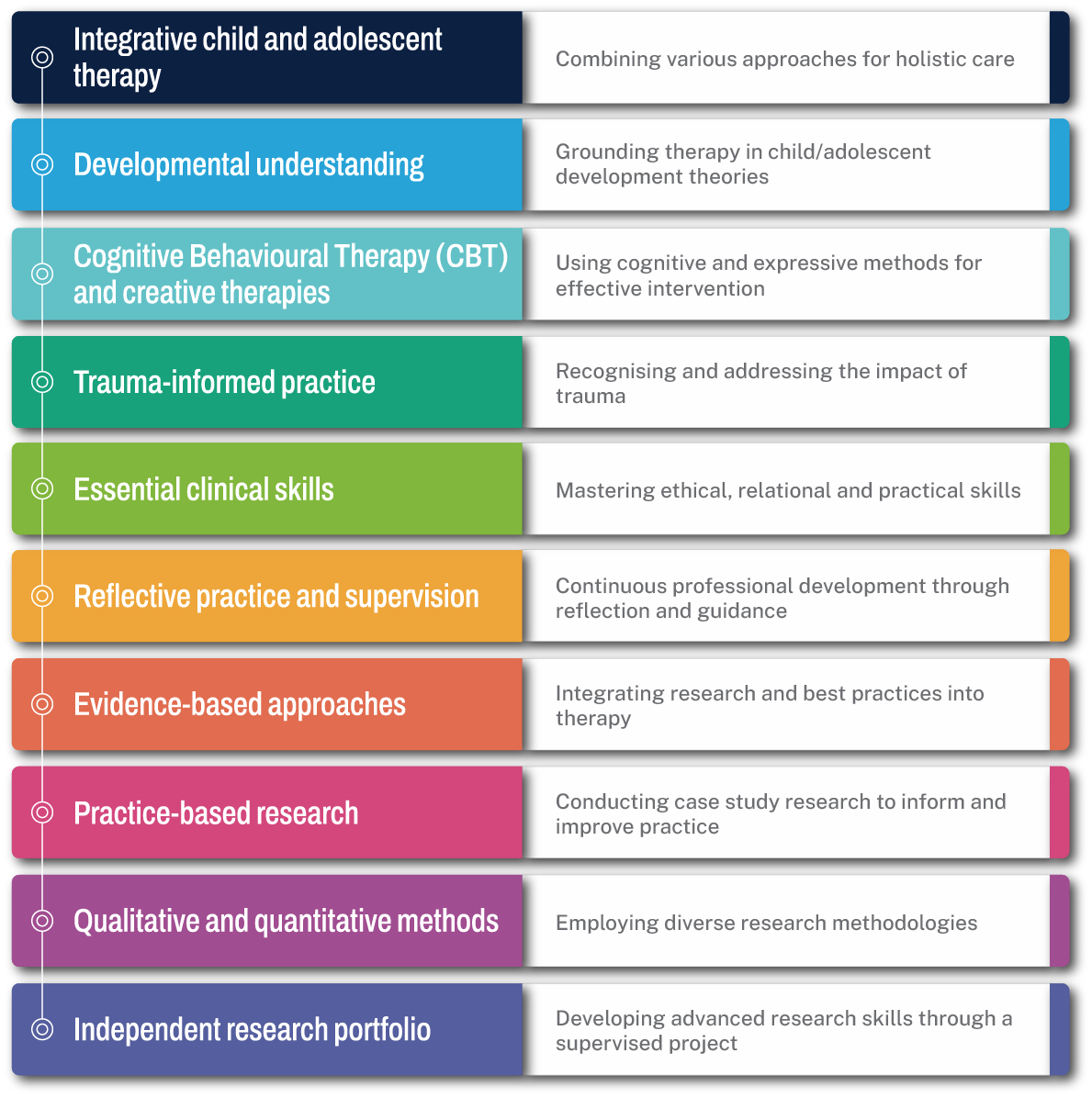
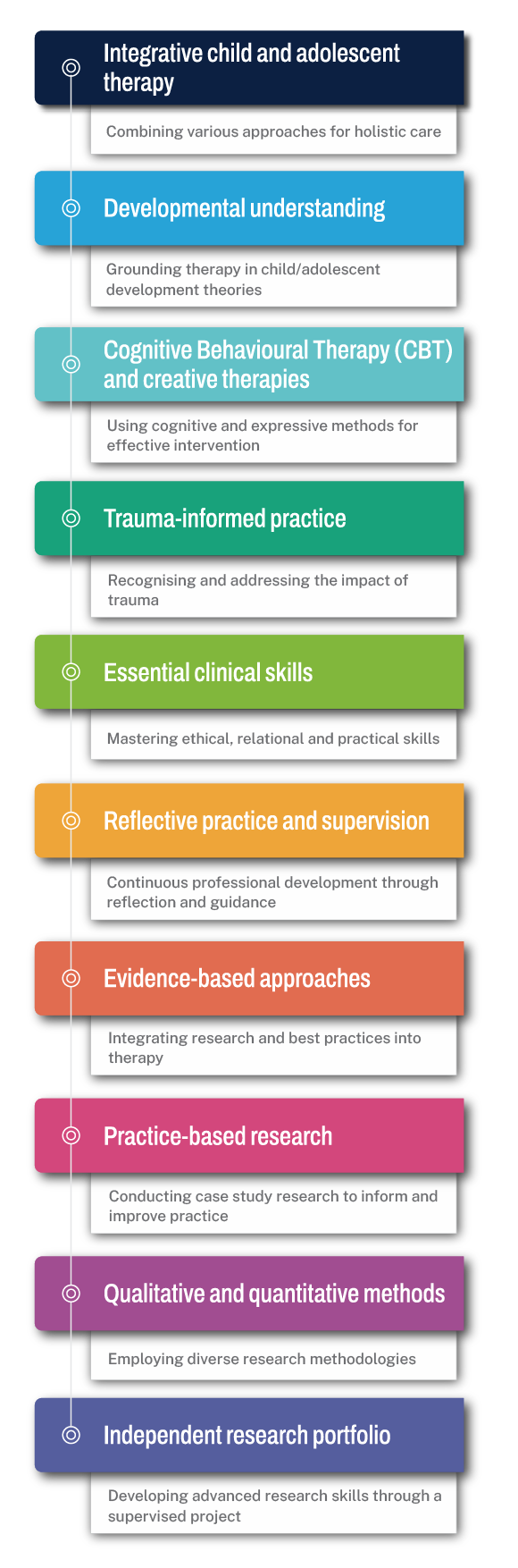
The programme is facilitated through monthly three-block days (usually Friday evening, all day Saturday and all day Sunday) and includes the following components:
Overview

This part-time programme consists of nine modules over two years. It is a taught master’s with a strong practice-based research component. It uses a continuous assessment strategy, with learners accumulating credits through a variety of assessments throughout the programme.

Delivery

This programme is delivered using blended learning. This consists of a rotational module, where learners attend onsite classes and online classes. We do not use hybrid approaches; therefore, onsite classes are integral to the programme.

Student Benefits and Support

We believe that it is not enough to simply teach the skills of counselling and psychotherapy. Learners are given the space to learn, practise and be supported as they extend the scope of their practice to work with children and adolescents.

Placement

As part of this programme, 100 hours of client work must be completed. Approximately 50 hours should be spent with children aged 6–11, and 50 hours should be spent with adolescents aged 12–17. A ratio of 60:40 is also allowable if a learner has a preference for working with one age group over the other.
Clinical hours must be completed in an approved setting, after completion of an assessment of readiness to practice with younger clients.

Learners are required to be in ongoing clinical supervision at a ratio of 1 hour of supervision to every 5 hours of clinical work, regardless of accreditation status. Supervisors for this programme must be qualified, accredited therapists and supervisors with one of the main recognised professional bodies in Ireland (i.e. IACP, IAHIP, BACP, IAPTP, APPI, FTAI). In addition, they must be experienced in supervision of clinical work with minors.

Assessment

Learners are assessed through a continuous assessment strategy, which includes a variety of methods such as individual and group projects, skills training
assessments, case studies and process recordings, written assignments, essays and a research portfolio.

Validation and Accreditation of Award

This programme is at Level 9 on the NFQ and validated by QQI.

Credits

90 ECTS

Programme Lecturers

Lecturers on this programme include:

  • Dr Linda Finnegan
  • Dr Grainne Ward
  • Jade Baron

The programme comprises nine mandatory modules over two years.

Psychotherapy with Children and Adolescents

This module aims to give learners a solid foundation in the theoretical and clinical underpinnings of integrative psychotherapy. It includes consideration of content such as the:

  • Goals of child therapy
  • Therapeutic relationship with children, adolescents and their caregivers
  • Attributes and skills of child therapists
  • Legal and regulatory context of child therapy
  • Process of psychotherapy with children and adolescents
Child and Adolescent Development

This module aims to give learners a solid foundation in developmental considerations and theories relevant to child therapy. They will engage with theorists such as Piaget, Kohlberg, Bowlby, Freud, Vygotsky, Bronfenbrenner, Lerner and Sameroff. Key developmental issues of stability-change, nature-nurture and continuity-discontinuity will be explored. Attachment theory and how attachment can impact the therapeutic process will also be examined. Likewise, learners will look at issues of developmental trauma and early life stressors, as well as consider key processes in developmental psychopathology literature.

CBT with Children and Adolescents

In this module, learners will engage in formal didactic lectures, skills practice, group discussion, reflective exercises and experiential exercises related to CBT with children and adolescents. This will include exploration of the theoretical and clinical underpinnings of Cognitive Therapy (CT) and Rational Emotive Behaviour Therapy (REBT), as well as consideration of case formulation. Learners will become familiar with the CBT model, the therapeutic process and alliance in CBT. They will focus on developing skills to identify and challenge negative automatic thoughts and irrational beliefs. The module is designed to help learners facilitate psychological understanding of CBT concepts with younger clients and facilitate change and acceptance with children and adolescents.

Therapeutic Use of Play, Creative Media and Expressive Arts

Malchiodi (2005, p. 8) argues that expressive and creative methods add a unique dimension to therapy, offering qualities not typically found in verbal approaches. When working with younger children and some adolescents, it is important to have multiple ways of engaging them. Not all young clients will have the same emotional vocabulary as adults seeking therapy. Engaging through play, creativity and expressive arts allows therapeutic work to occur through a medium that is comfortable for younger clients. Learners will engage in teaching and learning related to theoretical underpinnings of play, creative media and expressive arts in therapy. Projection and the use of metaphor and creative methods, including art, sand-tray work, and sensory and embodiment activities, will be used.

Clinical Skills for Child and Adolescent Psychotherapy

In this module, learners will engage in teaching related to the necessary clinical skills for work with children and adolescents. The module covers topics such as clinical skills for working with minors, confidentiality in the child and adolescent context, engaging effectively with parents and caregivers, and management of multiple stakeholder goals. The module is highly experiential, with inputs covering a range of areas, including ethics, boundary management, integration of theory and practice, case management and therapist development. Kagan’s Interpersonal Process Recall (IPR) is used to facilitate ongoing therapist development.

Advanced Research Methods

This module is designed to help learners appreciate the philosophical foundations for conducting research with children and adolescents and to understand why and how research is carried out in counselling and psychotherapy. It provides a practical, hands-on introduction to the process of counselling and psychotherapy research as well as an opportunity to develop and refine some of the core skills that will be used in the research portfolio. It adopts a practice-based approach to research, with learners completing case study research for their capstone module. This module, therefore, lays the foundations for this.

Research Portfolio

This module affords learners the opportunity to conduct independent, practice-based research under supervision. It fosters and develops a high level of independent research ability and skills. It also further develops learners’ skills in the conduct, presentation and reporting of qualitative and quantitative methods in case-based research. It assists with the intellectual process of conducting a research project by promoting learners’ ability to read widely on a subject, analyse various arguments and relate them to their own work. The portfolio will demonstrate their capacity to use practice to inform research and use research to inform practice. Throughout the process, learners will participate in one-to-one case study research supervision and clinical group supervision, where they will present the case(s) they will use in their studies.

Trauma-Informed Therapy with Children and Adolescents

This module aims to enhance learners’ understanding of trauma as it applies to younger children. Children or adolescents who have experienced trauma are at greater risk of developing a range of mental health problems (such as depression and anxiety), sleep disorders and substance use disorders (Substance Abuse and Mental Health Services Administration (SAMHSA), 2014). Learners will consider the impact of trauma on the biological, psychological and social domains. A child’s or adolescent’s experience with trauma can shape the manner in which they approach therapy and the psychotherapist.

Learners will also gain an appreciation of the relevance and application of trauma-informed therapy to youth mental health and adolescent substance use, as well as other sectors where there is a high incidence of trauma. Definitions of trauma will be presented, and learners will engage in teaching and learning relevant to trauma-informed philosophy and principles, the impact of trauma and implications for therapy.

Clinical Practice and Development

This module encourages learners to engage in evaluative case-related, discussion-based learning, which highlights elements of dialogue, critical discovery and community-based scholarly activity to explore and develop clinical placement, counselling and psychotherapy skills and practice as they relate to work with children and adolescents. The development of reflective practice is integral to this module, as is a deepening of knowledge, skills and competencies related to the practice of child and adolescent counselling and psychotherapy. Learners will engage in teaching and learning relevant to evidence-based practice, integrative assessment, ethical considerations and the use of self. Group supervision is integral to the module delivery, and consideration of case work in the group will be central.

IICP College understands that while partaking in further education is an incredibly rewarding experience, it can also be a financial challenge for some learners. To minimise the financial impact, we strive to keep course fees as competitive as possible. We also offer payment plan options to help learners pay the balance of their fees over the duration of their course.

*(Inclusive of QQI registration fee)

DepositBalance of FeesTotal
€1,305 (on acceptance of course offer)€3,045€4,350*
Overall Programme Fees

(Inclusive of €200 QQI registration fee)

*Following successful interview, a deposit of €1,305 is required to secure your place.

Year 1: Payment Options

(1) Pay in full before the start of the course.

(2) Flexible payment plan options are available (administration fee incurred)
.

Please contact us to find out more.

Additional Costs
Protection for Enrolled Learners

This programme is covered by arrangements under Section 65(4) of the Qualifications and Quality Assurance (Education and Training) Act 2012 whereby, in the event of IICP College ceasing to provide the programme for any reason, enrolled learners may transfer to a similar programme at another provider, or in the event that this is not possible, the fees most recently paid will be refunded. Current PEL arrangements consist of a 2% levy on course fees. IICP College does not pass the cost of this on to learners.

Take the next step